20 June 2013

Experience Report: Pairing with a Programmer

Background
It was one of those typical "do or die" scenarios: A feature was implemented that was critical for the project but it was delivered late due to slightly optimistic estimates. To make matters worse it touched on rather fundamental parts of the product making it somewhat complicated to roll back. The job was to quickly test, fix bugs and, in corporation with our product owner, decide if the feature was ready to be released. The feature in this case was rather technical with a simple interface that, depending on configuration, triggered tons of background activity including communication between different servers.

What we did
Me and the programmer teamed up. The first day we worked in front of his computer only. Initially he pretty much explained the feature and I noted down some thoughts and scenarios that popped up in my head. When done we started with the most straight forward scenarios and immediately found some serious bugs that required extensive investigation and experimentation to fully understand. We managed to solve the most critical ones and left not that late feeling really good about ourselves. Day two would be a breeze!

Day two we made an "upgrade" and booked a room as well as brought one computer each. Immediately we found out we had badly underestimated the work left as critical bug after critical bug emerged. As some of them required knowledge we lacked we called in a domain expert to help us and continued to work all three together for the rest of the day (one computer each). Day two turned into a 12 hour long exploration and bug bashing. When done we felt slightly exhausted but proud, it was working!

Some info about the group
I'm a decent programmer and a good tester. The programmer in this case is fairly young but good programmer progressively becoming a better tester. Finally the domain expert is a bit of everything. He knows the system and customers as well as having a fairly good understanding of both programming and testing.

Observations
  • We had fun! Personally I liked day one best, not because the presure was somewhat lower but because we cooperated more when sharing one computer.

  • Continuing on the track of computers: I think from an efficiency standpoint one computer each was, short term, mostly more efficient (possible exception would be during the most intense and mind challenging investigations). It's important to note that one computer each didn't mean we just sat together testing individually, what we did was to work together on one task but doing different things (like taking notes, executing tests, monitoring logs, correcting code etc.). Working together at one computer though was a more learning experience and, as I said before, I think it was more fun if that counts for anythings.

  • I feel very comfortable saying we would not had caught and fixed anywhere near the amount of bugs we did if working separately. A few reasons why:
    • We have different investigation methods. The programmer did low level investigations really well adding debug printouts, investigating code etc. while I did high level investigations really well checking general patterns, running additional scenarios etc. Not only did this make us avoid getting stuck by changing "method" but also, my high level investigations benefited from his low level additions and vice versa.
    • We could share some of the work, for instance I took notes as the programmer ran scenarios. This helped us avoid losing momentum.
    • No time was wasted performing handovers from bug reporter to bug fixer back to the reporter.

  • When we worked all three together I felt we often worked in one pair and one person alone (not all the time but most of it). In this case it was probably the right thing to do as we required all three persons' skills but I think that was an exception. My general judgement, only based on my own experiences, is there is little or no gain in being three compared to two if you don't really require everyone's skillset more or less constantly.

  • We learned so much!:
    • All three learned new things about programming, the system in general and testing, both from each other and from ourselves explaining stuff
    • I learned more about logging in general
    • I learned more about the system and feature
    • I learned more about the code/code architecture
    • I learned more about the others' strengths and weaknesses
    • The programmer got help being skeptic about his own code
    • The programmer learned some new scenarios his implementations need to handle

  • We got to know each other's personalities and skills better which fosters trust/respect/team spirit.

  • It made us communicate more which helped us gain from everyone's observations (sometimes an observation was communicated that didn't mean anything to the one making it but did to someone else).

  • Pairing also made us stay focused for longer stretches (you don't want to be the first one to procrastinate).

  • A byproduct was code review. As we investigated code sections other improvements/problems/potential problems became apparent and fixed.

  • One thought that popped up was working separately and then pair as problems occurred. However, that would require time to be spent rerunning the actions, explaining the steps and possibly missing crucial details from the initial run. All and all I think there's a place for that kind of approach as well but not that often.
Sum up
I did pair up with programmers quite a few times at Ericsson and found it useful but for some reason I haven't done it on my current job until now. I will definitely continue doing it though, for the learning experience, for the laughs and for the (at least perceived) efficiency gain. Luckily it seems I wasn't the only one feeling that way!

11 June 2013

Reflections and feedback request on communication

This is a post in which I will mostly ask for your help rather than me trying to help you. If that's not what you're after, feel free to skip to "Improving my communication" further down.

So what I would like from those of you still reading is any:
  • Exercises
  • Experiences
  • Advice
  • Helpful ideas
  • Free speculation
  • Things to look into
  • Things to think about
  • Other stuff you think might be helpful/useful
... related to what I'm about to describe. I leave it up to you to decide how to feedback but some suggestions are as comments to this post, email (brickuz(a)gmail.com), Twitter (@brickuz) or Skype (brickuz). Thank you so much for taking your time, I value this tremendously!

Disclaimer
I will talk about drifting as something bad. In many cases following thoughts to explore new ideas are  (I think) a great way to learn but the drifting I refer to is drifting away from a point I'm trying to make ending up with me not coming to any point.

I will also talk about communication only as verbal communication that is not (suppose to be) one-way.

Slowing down my tempo
I speak very fast, something I've done for as long as I can remember. The more excited I get the quicker I speak but it's an issue long before I get excited.

Problems: Sometimes people find it hard to pick up what I'm saying, it creates a barrage of words which makes people lose interest, it (I think) affects my credibility and it makes people lose track making it hard to get what I'm trying to say even when they stay interested and hear the words.

So far I've tried to actively lower my tempo but I quickly forget about it when discussions get intense or when I'm excited about the topic (as a passionate person that happens constantly). I've read before that it may be connected to stress, which is probably a factor and I'm trying to work on that as well, but I doubt it's the main reason. After all I've done this ever since I was a kid.

Lowering my voice
I often talk loud.

Problems: It can make it somewhat uncomfortable to listen to me for long stretches and it leaves a bad impression, especially when it's used to drown out other speakers (unfortunately not uncommon). The fact that I have a somewhat high pitched voice makes it worse I think.

I don't have perfect hearing but I also don't think that really affects this. I would rather say it's a bad habit I haven't learned to control. It also seems there's a connection between me raising my volume and my tempo which makes me believe there is something else that is the main problem.

Come to the point
I often have a point I want to make but I tend to drift off, simply because something pops up in my head and it immediately turns into words. A special case of this is when I throw out a claim and start reasoning around it (is it really true or not) as I speak. I do this in a way that, I don't think, is really helping anyone. Finally a third variant is I associate something said to something in my head giving me a starting point but not having any point to move towards. Even though this is the case I start talking and often end up in a situation there I'm desperately searching for a point to make AKA rambling.


Problems: A very common end result is lots of words, few relevant points which in terms makes people lose interest.

I try, but once again often lose the ability to when excited, to stop myself and just end my rambling as soon as I realize I've forgotten where I'm heading.

Stop interrupting people
I often interrupt the person speaking because I have a point, association or addition that fits in exactly at where we're at.

Problems: Apart from being rude/giving a bad impression, I make the speaker lose track/miss out on valuable information and it seems that interrupting others also makes it more okey to interrupt me more often.

My greatest ally in this so far is a well developed empathy. Thanks to it, "something" stops me and says: "if I speak now I'll likely hurt the person speaking's feelings, or at least rob him of the chance to shine"... not remotely close to stop me often enough though.

How did I come to these conclusions?
  • Stopping and reflecting on what just happened after I've gone bananas in conversations
  • I'm blessed with some really smart friends who care enough for me to give feedback
  • Observations of how people react to/act after I've spoken/rambled.
  • Reflecting on things said by people who don't like me.
Isn't this "just the person I am"?
I believe we all have various characteristics, like being impatient or humble. These provide us with some ups and some downs. I'm quite satisfied with the characteristics I have so I'm not really trying to "take the me out of my communication" but... it's also a lot about skill. Sure I get impatient or excited and that affects my communication, but on top of that there's a lot of skill I want to improve.

Why does this happen
Apart from impatience and excitement another thing that seems to "passively" affect my communication is fear. First it's the fear of people not letting me into a conversation. This, based on my own observations/reflections, makes me interrupt more often as well as keep talking without letting other people break in. The fear of not coming back into the conversation also gets worse the longer I go as I know people will hesitate to let me in again, for good reasons, when I stop. This is of course very counterproductive as people will stop listening at some point. Reading what I just wrote actually sparks some thoughts, we'll see where that ends up.

Second is the fear of forgetting about something that, important point, in the moment seems incredibly important (not so much when I say it though). I try to battle this by bringing a notebook but so far it hasn't improved the situation much.

Related to these fears there seems to be a mismatch between how I evaluate the "wow factor" of a thought inside my head compared to how it comes out. I don't think this is based on poor construction of the message, rather that I exaggerate the importance in my head. I think this mismatch is an important factor for me to generate a constant flow of ideas to explore so the problem is probably not the mismatch itself but rather that nothing stops my brain from communicating all those thoughts as soon as they pop up.

Improving my communication
In general, to battle these problems, I try to remind myself that people will only remember a few things I say (in general at least) so I better make sure that what I want them to remember is what's in focus rather than having it mixed up with a million other words and thoughts.

I try to stay aware of my though process and create a small gap between thinking a though and speaking the thought so that I can quickly make a rough estimate of: "is there a point relevant for this conversation in what I'm about to say".

I try to think more egotistically: When listening I generally learn more than when speaking. This way of reasoning has also made me use questions more often to still bring the conversations in directions I find interesting. One byproduct of doing this is I tend to communicate my own messages a lot more efficiently when baking it into this "question driven approach". Questions also help me stay focused on the current topic rather than drifting away. I thank Peksi and his exercise, as well as RST with James, for helping me learn how to do this.

Taking time to reflect, like in this blog post, helps me to become more aware of what I should think about/practice when speaking. Just getting this far has made me more aware of the silliness in many of my bad habits and ways of handle fear.

Moving on
Apart from putting my trust in some great things coming from those of you who have read this (grateful once again), one thing I've realized during these reflections is I should record my conversations and try to learn from listening to myself more often. Apart from learning more about my patterns I hope it'll make me better aware of how/when/why my speedy rambling kills any substance within.

Also I need to go into "practice mode" more often, observing myself as I speak and try to tweak the why/when/how/how much I talk instead of keeping my head busy with figuring out more things to say.

... I should do this kind of reflections more often it really generates interesting thoughts!

Wrap up
Thank you for surviving this rather long blog post. Please share your experiences and ideas regarding:
  • Speaking slower
  • Speaking more quiet
  • Getting to the point
  • Stop interrupting people
I really appreciate any input I can get!

(I keep coming back to the idea that I maybe should release a recording of me rambling... well, let's save that for another time .)

28 May 2013

Exploring what I know to learn something new

After reading an article tweeted by Tobbe Ryber I made an interesting connection...

Wouldn't a profile similar to what was described in the article be possible to create using Louise Perold's Test Planner from Let's Test?

So I quickly tried it ending up with the following columns:

Problem: What problems would I be able to solve for a company?
How: How do I act/what do I do to solve the problems I say I can solve?
Success: How would my work benefit the company? What will come of it?
Failure: How do I usually screw up / fail to meet expectations (incl my own)?
Data: What usually varies between companies I've worked for (how has that changed my success/usefulness)
Issues: What do I typically need from the company to function well?

When doing this I suddenly thought: Maybe the same approach could be useful when planning my CAST presentation? Or maybe when talking about the way forward with the product I test? Or maybe my travel to Madison? Or...

Well, I've just spent a moment thinking about this so it might be crap but I still find it interesting that something I learned specifically for testing seems to be useful in so many other contexts.

Thank you Louise for providing me with an interesting tool that seems to be useful in very many cases! (give me a day and the number of ways to use it will have grown substantially... I think .)

So how can I apply what Ilari, Huib, Jean-Paul, James, Johanna, Leo, Griffin, John, Steve, Zeger and Scott talked about in something else but testing? I'm inspired to figure that out next...

And how can you use what you learned in other ways than described/intended by the presenters? And what can you learn from doing that?

... Even more interesting: What, currently not test related, have you learned that could help you improve your testing?

Good luck exploring what you already know to learn something new!

23 May 2013

Let's Test - a summary


Sunday evening
  • You are never alone (if you don't want to)! Just sit down at a random table or start talking to someone you've never met before. If you don't dare doing that, just stand still and someone will approach you. The amount of people I got to meet in three days blew my mind! Thank you everyone!
  • The energy also struck me. Every discussion had a wonderful flow; people cared, people was thinking and people was curios.
  • Putting personalities and, sometimes, faces on people from Twitter was a cool thing. 
Keynote: James Bach, How do I know I'm Context-Driven?
  • We need to identify and clear shallow agreements. Questions are a great tool for this.
  • Context-Driven can mean a Paradigm, a Community and an Approach. Don't confuse the three, for instance, if your paradigm is Context-Driven you can't just jump in and out, you are Context-Driven (by choice) on the other hand, the community is something where you to some degree be part of while still being part of another community or having another paradigm.
  • Greeters and Guides are the people that introduce new people to Context-Driven Testing and help them and others grow inside the community. These people are key to making the community thrive.
Tutorial: Ilari Henrik Aegerter, The Challenges of Brilliant Observations...
  • People take their decisions based on what they observe, or rather perceive they observe. This makes observational skills a key in most aspects of life. In testing they are our bread and butter in finding/providing important information.
  • There are so many things biasing our observations (old models, language, instructions/provided information, distractions and a whole lot of other things) and we can't do much about many of them per se. However, knowledge and critical thinking can help us be aware and chose different approaches to help work around them.
  • When communicating observations it's important to avoid ambiguity when possible: this is (what is "this"?), preferred (by who?), few (in comparison to what? how many?).
Comments:
I love how Ilari approaches questions. He has an amazing ability to just suck up the question, think, ask for additional information and form a well constructed answer in seconds, through all this he always keeps his calm. I have a lot to learn from this guy! (especially as someone opening my mouth before even starting to think ,)

I also like how Ilari left us with a lot of tools but not much instructions on how to use them. I've already taken on the challenge of finding ways to incorporate this new knowledge in my daily work.

Tutorial: Huib Schoots and Jean-Paul Varwijk, Thinking and Working Visually
  • Give visualization a chance! You don't have to be an artist to sketch, make mind maps or add illustrations, but you do have to actually try!
  • Cover your walls with sketches, diagrams, illustrations and other visual representations of you work.
  • Get a magic marker (Edding 345, grey marker, edding.com, EAN: 4 004764 841592) and even your bad images will start to look cool. 
This is what you should aim for in a tutorial. Left is before, right is after, can we agree that this is a significant improvement? (even without the magic marker by the way). With better light and some quick editing these visualizations could also be used in future blog posts, cool bonus!

Monday evening: Takeaways from discussions
  • Every time I do even the slightest attempt to use the Socratic method I and, as it seems, others learn something. Driving a discussion using questions is a rewarding and useful skill!
  • A role is not the same as responsibilities or skills.
  • If everything is considered priority one, nothing becomes priority one.
Keynote: Johanna Rothman, Kick-Ass Manager
  • Where do you want to go, what career paths matters to you?
  • To the business, bugs are not an interesting problem, but the complications of them are!
  • What is relevant changes over time, you might one day wake up and realize perceived quality is suddenly a much more important issue than functionality and rapid shipping (or in any other order).
Comments:
For most summaries I've tried mixing what the presenter seemed to focus on and what I took away. For this keynote it's only what mattered to me cause I had three things that really did matter. I urge you to check out this keynote yourself when/if it becomes available! (in case you weren't there)
Session: Huib Schoots, Future Roles and Trends in Testing
I could list the things discussed (or well, actually I couldn't since I didn't write much of it down) but the list, as Huib said, is not what's relevant. Instead, start thinking about what might happen, how that affects your work and prepare yourself for what's relevant to you. It's a huge topic and there are obviously no known answers but you better be ready cause the future will happen no matter what you want.

Session: Leo Hepis, Linguistics, How to Keep a Dialog Constructive
  • Volunteer! You might feel uncomfortable being put in the spotlight but look at it as an amplifier for learning. Also, if you're one of those who want to build a brand I image this is a good thing to do cause I've not lowered my respect for any of the volunteers in any of the sessions I've attended but I've sure found a couple of people who've earned my respect by doing it (and sometimes you get away with cool stuff, right Kristoffer? .)
  • Keeping a discussion cooperative is key if you want to effectively transfer information.
  • At least for me, it's easy to provide an answer before I'm sure of what answer I really should provide.
Session: Griffin Jones, What is Good Evidence?
  • Griffin had a lovely list of attributes to check for in a piece of evidence, check out his slides!
  • There's a difference between what we actually did and what we intended to do (hello "passed" test case, I have no idea what actually made you "pass").
  • Discouraging feedback, like leaving out confusing/unexplained/contradictory details/data/observations or other things that might conflict with your verdict, hinders the possibility to critically analyze a piece of evidence, which hurts the validity of your evidence.
Session: Louise Perrold, The Test Planner
  • Start with Problems: Which are the business problems we try to solve with our product?
  • Make additional columns for each of the things below and populate them as well with items:
    Success, what represents good
    Failure, in what ways can the product fail, what consequences may occur
    How, how can we test this product (logistics and techniques)
    Data, what variables do we have
    Issues, what do we need, to be able to test
  • Use the items from each column to inspire/spawn new items in the same or other columns. Repeat until satisfied.
Comments:
Probably the most "loosen up" (laughing, smiling, chatting, casual) session I went to, which was a great thing. Don't know if it's a coincidence / wishful thought but I feel like I remember more from this one than most others.

Bug hunters will notice "Data" seems a bit out of place... answer is quick and dirty graphics editing on a really not professional level.

Tuesday evening: Test Lab
  • A great test leader can really make a difference! Less control more empowerment (e.g. coaching, empathy, support, freedom) is one of the keys to that for me.
  • It's really fun to sit in a tight group and just work together focused to find relevant product information (feel free to call it bugs in this specific case). By the way, I'm at a company where we already do that and it's just as fun "at home"!
  • It's hard to explain a bug in purely text, images and/or videos are often great compliments.
Session: John Stevenson, Information Overload and Bad Decisions
  • S L O W   D O W N !
  • For instance requirement documents can prime/anchor you to certain solutions limiting your ability to see important options. Be aware of this.
  • We often make quick judgements instead of think. We need to be aware of this and apply critical thinking to avoid missing key observations.
Session: Steve Smith, Debugging Human Interactions
  • There is a relationship between low self esteem and very active defense reactions.
  • We don't receive sensory input (like seeing, hearing etc.) in an objective way. Reactions to certain sensory input can for instance make us shut down/forget/ignore other sensory input.
  • Being aware of how sensory input is "used" (forming one or more meanings of the input, feelings, feelings about having these feelings, prepare defense mechanisms and setting rules for commenting) can help understanding your or someone else's reaction.

Session: Zeger Van Hese, Testing In The Age of Distraction - The Importance of (de)Focus
  • Y O U   D O N ' T   N E E D   T O   R E S P O N D !
  • Receptive distractions reloads/refreshes us. Examples: taking a walk or having a coffee
    Deceptive distraction drains us. Examples: meetings or emails
  • Observe when you start to procrastinate and see if you can find certain patters/scenarios.
Comments:
Zeger commented that flow, in the original description, "suspends critical abilities", which might be a bad thing for testers. My interpretation is that it rather inhibits what may distract you from proceeding and in a regular creative activity that thing is criticism but in testing, criticism is more or less the "creative activity" itself. I would instead interpret flow, in the context of for instance exploratory testing, to inhibit the risk of you rejecting a critical observation. But that's just a thought that popped up as I reread my notes. Feel free to comment or question (directed to anyone, not specifically to Zeger).

Keynote: Scott Barber, Business Value in Testing
  • Testing as an isolated activity has no value... but the resulting information is worth something.
  • Sometimes the needs of the Business overrides the needs of the Users (e.g. a product must get out on the market to not miss a marketing window).
  • It's important for testers to learn basic business lingo to improve our ability to communicate information. Hopefully that can also motivate business people to learn basic testing lingo as well.

Reoccurring themes throughout many of the conversations and presentations I attended
  • We need to stop multitasking!
  • Beware of various kinds of bias that limits what/how we observe.
  • People, people, people! Like it or not, our business is all about people!
  • Keep things simple! E.g. leave out redundant/irrelevant information.
  • We need to understand the business implications of what we do.
Some comments I liked
Notice! None of these are exact quotes (I suck at noting down exact quotes), I hope I haven't messed up the original meaning due to this, please correct me if that's the case!

Great enough instead of good enough or perfect
/who said this, Martin? Leo? Maria? Was after Steve Smith's session.

Jerry Weinberg is Yoda
/James Bach, keynote, completely taken out of context by the way

It's all about following your energy
/Huib Schoots, lunch

There's no reason not everyone can become awesome
Johanna Rothman, keynote

A few people that really made an impression on me
I started making this list but soon realized I had at least 20 people I wanted to add and it just became silly. But, stubborn as I am, I want to highlight three:

Richard Robinson
For a Miago Do belt Rich got the challenge to form and lead a test team with the mission to test XBMC for roughly an hour and a half and finally debrief the results. I was fortunate enough to be part of this team cause the experience itself was awesome and I think Rich did a kick ass job! Whenever I'm doing something test leader:ish he'll be my role model! (read the first item in the Test Lab summary further up for some reasons).

Huib Schoots
Pure energy on two feet and with a well earned Buccaneer cap on his head. Interesting, helpful and intelligent. His (and Jean-Paul's) visualization tutorial also had an instant effect on my notes which was awesome! Next mission, inspired by the mentioned tutorial and other discussions, is to cover the office with various visualizations of our product.

Johanna Rothman
Apart from delivering a keynote that helped me realize/explain certain things (see summary further up) I really enjoyed just speaking to her. Apart from curiosity, a willingness (or even urge) and ability to help, she seems to deeply care about everyone she's speaks to. Amazing person, I truly value what she taught me during meals and through her keynote! Yeah, and it's hard not to mention how she stands up for what she believes (I think everyone attending Let's Test knows what I mean)

A lot of other people deserves more than a short mention, like Helena, Steve, Jari, Ilari, Jesper, Martin, Kristoffer... but the line has to be drawn somewhere. But let me just say: Thanks to all of you for the amazing discussions, exercises and lectures I've had during my last three days! I deeply appreciate every single one of them!

Wrap up: The Taxi Driver
In the taxi back to the train station I spoke to the taxi driver. I think his story well summarizes what people on Let's Test was all about.

Short version is he had been a hairdresser for 15 years but lost his energy. So he changed career and started driving a cab. What he loved about it was feeling free and the human interactions, he also liked how his taxi company's ethics resonated with his own. When listening to him my impression was he loved his job and that he truly cared about being the best taxi driver he could ever be. Even though leaving Let's Test I was smiling the whole way, that guy would had fitted perfectly at Let's Test.


14 May 2013

Key testing skill: Thoughts into words

Background
During SWET 4, one thing that really struck me was how amazing the other participants were at quickly and accurately turn their thoughts into words. It was probably the most striking difference I noticed between myself and these experienced testers. Since then I've kept thinking about this skill and how to improve it. This is my thoughts so far...

Why
One of the early slides in the RST material starts with: "Testing is in your head" which I think sums up why this skill is so crucial. You need it if you want anyone to understand anything about your testing. Some examples; you need it to get:

  • Programmers to understand your bugs
  • Stakeholders to understand why these bugs are important
  • Your employer to know why (s)he needs you
  • Your colleagues to know what you're doing and how it's going
  • Anyone to understand your problems
  • Stuff on paper (strategy, results, methodologies etc.)
  • You to understand for yourself what you are doing/have done
Notice the list doesn't mainly consists of stuff only some test thinking expert needs to master, it's stuff every tester needs to master!

How can you improve this skill?
Since this skill is fundamental to testing you will practice it to some degree by just doing ordinary work but the ideas I've listed below are ways I've found more efficient either as ways to practice the skill or to get feedback on how well you're doing.

Answer the fundamental questions
For many questions the answer is far less useful than the process of getting to an answer. Some examples in testing:
  • What does it mean to test something?
  • Why do we need testers?
  • Can't programmers test themselves?
  • What's the tester's role?
  • What is a bug?
  • Do testers need education? Why? Why not?
  • Can we find all bugs? How? Why not?
  • How do you know when you're done testing?
  • How can we measure efficiency of testing?
  • How do we know what's important?
  • Why do we run extreme tests?
  • Can we on beforehand figure out what to test? How? Why not?
  • If we know the status of a product shouldn't we decide whether or not to ship?
Can you answer them? Is your answer a quote from some famous tester like "a bug is something that bugs somebody who matters"? How do you know who matters? How do you know what these people think? Is it enough if one out of a million of these are bugged? Two? Five? A hundred? If we expect someone to matter later who we expect will be bugged about this, is it a bug? If people who matter don't know about something, e.g. a missing link, but would love it, and be bugged if it was later removed, is the fact that it's missing a bug?

The questions I asked above is exactly the kind of questions I want to you ask and try to answer. It's a kind of mental gymnastics that will not only help you improve your ability to put thoughts into words but it will also help you learn a lot more about testing (which will be a common theme for the rest of this blog post).

Blog
I brought up the importance of blogging way back in my 2012 refelction posts, there you can find a bunch of motivational links and tips on why to blog.

Anyway, I get two things out of blogging relevant to the topic:
  1. Feedback on how well I present/explain my thoughts (if people read and react)
  2. An efficient way of practicing the act of putting thoughts into words
The second point depends on that I write about my own thoughts and not just reference what other people say.

Talk about test
Talk to colleagues, speak with people on Twitter, go to conferences/meetups, present. All these things force you to practice the art of putting thoughts into words, some of them also force you to do it rapidly to keep the conversations going which adds another dimension (which, for instance, blogging doesn't).

Explain what you do to non-testers
Have you ever tried explaining what you do and why it's important/interesting to someone like, say your mom? Or boss? Or best bud? Or some programmer you know? Or maybe you from before you became a tester ("hey myself, you're going to become a software tester and you'll love it, let me explain to you why!")? Try it, it's a lot harder (at least for me) than you might think. Also it really forces you to look deep into your thoughts to find out what things really mean to someone not familiar with testing (sometimes it helps you figure out what stuff really means in a more general/other context than testing).

Ask for feedback
It's important to practice but it's also important to know if your efforts are paying off. "Am I really better at explaining what I do know?". You can ask pretty much anyone how they interpreted you explanations and/or how easy they though your explanation was to understand. Here are a few quick, general example:
  • Was my last bug report clear to you? Did you miss something?
  • Was my last debrief useful? What could I've done to improve it?
  • Did you understand my explanation or what part was hard to understand?
  • Is it clear to you why I think we need to use an exploratory approach?
Question stuff
If you walk around and accept not understanding what others try to communicate to you I believe there's a great risk you do the same about your own explanations/thoughts. Try to get out of this by questioning anything you don't believe in and ask for another explanation whenever you don't understand something. I've found this to really help me question my own believes, assumption and opinions.

Good question to ask yourself after any explanation:
Would my dumbest colleague understand this and why not?

As a recommended reading on this I really love this blog post from Tommy MacWilliam.

Mentor someone
I've just done this briefly but I find it a great way to force myself to explain in detail what I'm doing and why. It also provides me with a great possibility to get feedback, both verbally and as I monitor my pupil's improvements.

Rapid Software Testing
The Rapid Software Testing course is a lot about trying to get you to think like a top notch tester. One of the key aspects practiced during this course is explaining what you do (putting thoughts into words) and build the courage to do so. I highly recommend the class for many reasons, this is definitely one!

Summary
Putting thoughts into words is key when doing any form of testing (planning, executing, bug reporting, following up etc.). Ways I've discovered that works well for me to practice this skill is:
  • Question the answers, why is this answer true? Is it really true in this context? When is it not true? Why?
  • Try to come up with your own answers and refine them using questions
  • Blog, or write about testing in some other way
  • Talk testing whenever possible
  • Ask for feedback
  • Don't accept not understanding neither your own nor others explanations
  • Become a mentor to force yourself to communicate your thoughts
  • Rapid Software Testing is a great course to help you improve this skill

14 April 2013

ConTest (meetup) - Security Testing

What is ConTest?
ConTest (link in Swedish) is a local test meetup in Malmö, Sweden started by Henrik Andersson (please correct me if I'm lying). Each meetup they have a theme and participants provide content by sharing short presentations/lightnings talks (approx 5 mins) that are followed by a facilitated discussion.

First Talk: Martin Thulin: Learning Security Testing
Martin, just like me, started exploring the world of security testing quite recently. In his talk he went through his top three resources for self-education in security testing:
  • Google security blog
    General information about online security
  • OWASP
    Great cheat sheets, basic security information, list of security testing tools and much much more.
  • Hack this site
    Step by step hacking challenges used for practice/learning.
But maybe most importantly he shared the message:
"Anyone can become a hacker"

Great topic and great presentation!

In the discussion that followed tons of resources came up. I won't list them all here, instead I urge you to check out the #foocontest hashtag in Twitter..

Second Talk: Me: Quick Tests in Security Testing
Quick tests are cheap (quick, simple, low resource), general tests that usually indicate the existence, or potential existence, of a common problem or group or problems. Even though rarely proving the absence of a certain problem they can often be a good start to help you highlight common problems early (disclaimer: this definition/description of quick tests might not match with James Bach's and Michael Bolton's that is used e.g. in RST).

I spoke about two quick tests (for web) I've used:
  • Refresh
  • Cocktail string
Refresh means whenever I find a page that seems to make a lot of database calls, heavy calculations or connect to external servers (like an email or SMS server) I simply press and hold F5 (refresh) for a short while. What I'm looking for doing this is database errors, any changes in content/design, error messages in general and a finally fully context dependent stuff like received mails when the page is calling an email server or alarming patterns in logs.

In practice I've used this to take down a couple of databases (or rather connection to the databases). Simple and effective. Credits to Joel Rydén by the way who taught me this.

The idea with the Cocktail String is described in a separate post.

As a bonus I can provide you with a few other:

  • Scramble cookies
    Just quickly change the contents of cookies a page creates. Try both to generate errors by e.g. use strings where a number is set, use other plausible values (0 is always interesting, negative values as well) and combine with the cocktail string.
  • Back button
    When viewing sensitive data, log out and try pressing back. Is the data visible? Common and scary bug in some systems (systems expected to be used on any shared computer/handling very sensitive data), irrelevant in others (remember browsers deal with caching differently).
  • Bob
    When creating an account first try password "bob". It's so insecure very few systems should allow it (but does).
Final Talk: Sigurdur Birgisson: Security, Usability... huh?
I was a bit disappointed about Sigge's talk, not that it was bad (it was actually awesome) but because I was hoping he would share something really smart about how to deal with the often conflicting wishes of security and usability (like captcha). It also had very little to do with security testing, but who cares...

So what was it about? Sigge talked about how he thought the quality characteristics (CRUSSPIC STMPL mnemonic) were often interpreted as too abstract when talking to stakeholders. Instead he used the Software Quality Characteristics published on the Test Eye. What he did was he printed a card for each "sub characteristic" and, for best effect, tried to add matching examples from the product examined. The goals were both to get the cards (characteristics) prioritized to aid the testing focus, to support a healthier discussion of what the product needed to do as well as to make stakeholders care for them (it's not just about new features).

- It must be quick, quick is above everything else!
- What about data integrity?
When I said that, the customer started to hesitate
// Sigge

Henrik Andersson also shared an interesting story related to this presentation where he had gotten the top managers in a company to prioritize the original 8 quality characteristics (CRUSSPIC) in the context of a product and used this both when testing and when reporting status. Brilliant as well!


There are a lot more to say about this presentation and I might get back to it in the future. For now, just check out Sigges blog. Finally it made me think of ways to improve my own ongoing prioritization job with my product owner, for that I'm really grateful!

Summary of ConTest
Great people, great mix of people, great discussions, great presentations, great facility, great to meet Sigge before his Australia adventure, great to meet Henrik Andersson for the first time, great to try ConTest's format and great to get new insights about security testing. ConTest was a blast! Thank you Malmö, Foo Café and all the ConTest participants!

11 April 2013

Cocktail Strings - Quick Test for Web Security Testing

This is a part of my talk on ConTest this evening. I started blogging about the whole event but time is running out so I'll start with this and provide you with the rest tomorrow.

Cocktail String?
Cocktail String are a form of quick test that can be used in security testing. The idea is a general string with a mix of ending characters and other stuff that can be used for MySQL injections, XSS and similar. Here's the example I provided:

'"$%>*<!--

The initial single and double quotes are to screw up badly sanitized query strings or similar, the $ is to get an error in case the string is evaluated as PHP, %> is to end a PHP or HTML tag, the star I don't know what it's for but since it's often used as wildcard in various situations I figured it might provide something and the ending <!-- is my secret weapon as it safely, but with a cool effect, exposes possibility to execute user defined HTML (and thus potentially scripts like javascript).

Where to use?
The string, or variations of it, can be used wherever users can send data to a server like in forms (especially look for hidden form named "id" and similar), cookies, file uploads, HTTP requests etc.

What are you looking for?
Exactly what to look for depends on context but here are a few suggestions:
  • Any kind of errors like no database connection, faulty query errors, code errors etc.
  • Garbage being printed on the page
  • Any irregularities on the page (even subtle design changes like an extra line break)
  • Check HTML code for occurrences of the string
  • Check for errors in any logs
  • If used in combination with databases, check the database content
  • Check cookie content
Actual examples
I names my user this on a server application. Everything was fine until I started the administration interface, suddenly I couldn't see anything but a few garbage characters on a white background. The reason was the user's name wasn't sanitized on the admin pages but everywhere else.

Another similar example was when I used it as name for an item occurring in a log blanking out everything showing up after that log entry.

Finally I  used it on a friend's project to highlight MySQL injection possibilities.

Ways to improve it
Many great suggestions to improve the string came up during the meetup. One was to add unicode versions of certain characters since this for instance fools some sanitation functions built into PHP as well as other sanitation plugins. Another was to add international characters including stuff like Arabic and Japanese. Finally Mattias suggested using an iframe instead of the comment tag at the end since loading a scary page is even more striking than blanking out half the page (as well as actually proving a really destructive bug exists). Cred to a lot of people for all the great suggestions (especially Simon for unicode, I'll add that for tomorrow's testing!).

Finally notice you'll have to change this string to fit your context, for instance a string used on an ASP.NET application or a Java desktop application looks different.

Automation
One interesting comment that came up was automating this (which is typically what security scanners do already, by the way). First off, it's suited really well for random automation that just sends various combinations of dangerous characters into every field it finds and compares for instance HTML output to a control. Might miss stuff / give a lot of false positives but still a great way to work with it. It also addresses one of the weaknesses with the string; since it uses so many different commonly filtered out characters the string might get filtered out due to one character while a couple of the other would have worked in isolation (this is typically what I mean when saying quick tests rarely provide evidence that a certain problem can't exist), with the speed of automation (assuming you achieve that) you could test them more one by one as well as in more combinations.

Summary
So a bit of a messy post but long story short:
Instead of Bob, name your next test user '"$%>*<!-- and let it live in the lovely city of '"<!-- with interests in  '"$% and >*<.

Good night!

09 April 2013

EAST meetup - talking metrics

Yesterday's EAST meetup was focused on test metrics, starting with us watching Cem Kaner's talk from CAST 2012 and then continuing with an open discussion on the webinar and metrics in general.

Cem's talk
Cem talked about the problem to setup valid measurements for software testing and the work he presented on threats to validity in measurements seemed very interesting (you can read more about that in the slides). He also talked about problems with qualitative measurements:

  • Credibility, why should I believe you
  • Confirmability, if someone else analyzed this, would that person reach the same conclusion
  • Representativeness, does this accurately represent what happens in the big picture
  • Transferability, would this transfer to another similar scenarios/organizations

So far so good.

But Cem also, as I interpreted it, implied that all quantitative measurements we know of are crap but if a manager ask for a certain number you should provide it. In this case I agree we testers in general need to improve our ability to present information but, as I will come back to, I strongly disagree with providing bad metrics even after presenting the risks with them.

How do you measure test in your company
Everyone was asked: How do you measure test in your company. The most common answer was happy/sad/neutral smilies in green/red/yellow, which was quite interesting since it relates closely to emotions (at least as it's presented) rather than "data".

The meaning of the faces varied though:

  • Express progress, start sad and end happy (="done")
  • Express feelings so far, first two weeks were really messy so we use a sad face even if it looks more promising now
  • Express feelings going forward, good progress so far but we just found an area that seems really messy so sad face (estimate)
In most cases some quantitative measures were used as input but wasn't reported.

My personal favorite was an experiment Johan Åtting talked about, where a smiley, representing the "mood" so far (refers to item two in the list above), is put on a scale, representing perceived progress (see picture). Seemed like a straight forward and nice visual way to represent both progress and general gut feeling. The measurements of progress in this case were solely qualitative if I understood correctly but would work if you prefer a quantitative way of measuring it as well.


Also a couple of interesting stories, both from the great mind of Morgan. First was an example of a bad measurement with managers basing their bonuses on lead time for solved bug reports. This was fine as long as developers had to prioritize among incoming reports but when they improved their speed this measurement dropped like a stone (suddenly years old, previously down prioritized, bugs were fixed) and managers got upset.

The second story was about a company where developers and "quality/production" (incl. testers) were separated. Testers in this case tested the components sent from developers in isolation before going to production. However, when the components got assembled tons of problems arised, problems customers reported back to the developers without quality/production knowing it. This lead to a situation where quality/production couldn't understand why managers were upset with bad sales, the product was fine in their view. The situation improved when Morgan started to send the number of bugs reported from customers (bad, quantitative measurement) to the quality/production department.

An interesting twist was later when they tried to change the bad quantitative measurement with something more representative and met a lot of resistance since management had learned to trust this number. I asked him if he in retrospect would had done anything differently but we never got to an answer.

I shared a creative test leader's way of dealing with number. She reported certain information (like test case progress and bug count) but removed the actual numbers. So when presenting for upper management she simply had visual graphs to demonstrate what she was talking about. As far as I know this was well received from all parties.

Finally an interesting comment from Per saying: "Often I find it more useful to say; give us x hours and I can report our perceived status of the product after that".

Epiphanies (or rather interesting insights)
During the discussions I had a bunch of interesting insights.
  • Measurements are not a solution to trust issues!
  • Instead of saying "we have terrible speech quality" or "the product quality is simply too bad" we could let the receiver listen to the speech quality or demo the aspects of the product we find bad. It's a very hands on way to transfer information we've found.
  • Ethics is a huge issue. If we want someone to believe something we can (almost) always find compelling numbers (or analysis for that matter).
  • Measuring progress or making estimations will not change the quality of test/product's state after a set amount of time (just as a reminder of what you don't achieve and the cost of measurements).
  • If a "bad measurement" can help us reach a better state in general (like in Morgan's example), is it really a bad measurement? (touching on ethics again).
  • When adding qualitative measurements to strengthen our qualitative measurements, are we digging our own grave? (risk of communicating: So it's not my analysis/gut feeling that matters, it's the numbers)
  • How a metric is presented is often more important than the metric itself.
  • In some cases brought up the measurements weren't even missed when not reported anymore.
  • Don't ask what reports or data someone wants, ask what questions they want you to answer.
  • Cem talked about transfer problem for students, making it hard for them to understand how a social science study can relate to computer science for instance. I think the same problem occurs when we move testing results into a world steered by economics (numbers).
  • Even bad measurements might be useful to highlight underlying problems. Once again Morgans examples somewhat shows this and Per talked about how more warnings in their static code analysis was an indication programmers might be too stressed (if I interpreted it correctly). In these cases it's important to state what the measurement is for and that's it's just a potential indication.
Measurement tempering
We talked about how we easily get into bad habits/behavior when quantitative measurements becomes "the way" to determine test status.

Bad behavior when measuring test case progress:
  • Testers saving easy tests so they have something to execute when the progress is questioned
  • Testers running all simple tests first to avoid being questioned early on
  • Testers not reporting the actual progress to avoid putting too much pressure on them or to fake progress to calm people down.
  • Testers writing tons of small simple tests that typically test functionality individually which creates a lot of administrative overhead as well as risk of not testing how components work together, this to ensure a steady test case progress.
  • Test leaders/managers questioning testers when more test cases are added (screws up "progress"), as a result, testers ignore broadening test scope even when obviously flawed.
Bad behavior when measuring pass/fail ratio:
  • Ignoring bugs occurring during setup / tear down.
  • Slightly modifying a test case to make it pass (making it conform with actual result rather than checking if that's a correct behavior).
  • Slightly modifying a test case to make it pass (removing a failing check or "irrelevant part that fails")
Culture
We also talked about how the culture (not only related to test measurements) in various countries affected testing. One question was: Why is CDT so popular in Sweden. Among the answers was low power distance (Geert Hofstede, cred to Johan Åtting), Law of Jante and that we're not measured that much in general (i.e. late grading in schools, not grading in numbers etc.).

We also talked about drawbacks with these cultural behavior (like hard to get to decisions since everyone should get involved/agree).

Finally, and mostly, we talked about how our view on testing and measuring sometimes collides with other cultures, with actual examples from India, Poland and the US. This discussion was a bit fragmented but feel free to grab me if you want to hear about it.

Summary
This was a great EAST meetup and I really feel sorry for the guys I know like this topic but couldn't attend. Definitely a topic I hope (and think) we'll get back to!

Finally a lovely quote from Magnus regarding a private investigator determining time to solve a crime:
"Let's see, there are 7 drops of blod, this will take 3 weeks to solve".

Good night! .)

10 March 2013

EAST meetup - Trying a new format

What is EAST
Short version: EAST is a local network for software testers in the area I live (Linköping, Sweden). About once a month we meet to share thoughts, learn and socialize/network. If you want to know more you can read my post from my first EAST meetup.

New Format / Concept
Most previous meetups have followed the format: Start with food and socializing, then 1-2 presentations, each followed by discussions. A few other formats have been used, like letting each participant shortly describe how testing is performed at his/hers company (try to get everyone involved), testing games and the pub evening with only beer and socializing. This time some hands-on testing was on the menu.

Webinar
As usual we started with food but instead of casually chatting with each other we together looked at the Six Thinking Hats for Software Testers by Julian Harty (referring to Edward de Bono's thinking hats). The webinar was interesting but I missed the social part. Maybe a 5-15 minutes long webinar would have worked better for me.

Hands on
Second part was hands on. First David, the facilitator, quickly presented the application we were to test and how to get it. The application in this case was an app for taxi drivers to help them keep track of their work (part of a full system for taxi companies). Second we would, in groups or alone, test the application using the six thinking hats in any way we saw fit.

First I and a former colleague from Ericsson started out exploring/scouting the app but soon felt we didn't get any momentum and joined another group of three. A vivid discussion on how to use each hat and what fitted where ended with us being ready to actually start generating test ideas about 5 minutes before deadline but that didn't matter, at lot of interesting stuff came out of the discussions.

Sharing results
When we were back together we started the sharing of ideas and experiences from the hands on part. Immediately it became clear the various groups had used the hats very differently.

We attacked the whole app and used the various hats from the perspective of an actual user (or rather our made up view of how it was to be a taxi driver, lesson learned: better understanding of the user; for instance its needs, knowledge and general behavior, would have helped a lot). This perspective gave us an interesting high level view but it was a bit hard to stay focused as we often drilled down too deep exposing too many details. Others focused on a smaller part of the app which, in this case, seemed a lot more efficient.

Of course how to use the hats would depend on the mission in a real life scenario but in this case the mission was not set like that, the goal was just to try out the hats and learn from each other's way to approach the hats and for this, our perspective took a little too long / became a bit too complex, at least for beginners like us.

Wrap up
To wrap things up we had a more general discussion about the hats and format.

A few thoughts about the hats:
  • In this scenario we had no problem coming up with ideas quickly and the hats initially felt more limiting than helping. In a situation where we would have been stuck or at least worked with the product for a bit longer, the hats would probably had been more helpful. This might also change as we get better and better at using the hats but only time can tell how that turns out.
  • Keep using the hats on items already identified would probably render interesting results. For instance first we could use the white hat to identify a data item, say cars in the Taxi app, then we could use the hats on this item to identify risks (lack of cars), opportunities (more efficient usage of cars), new data (various types of cars), feelings (lust to drive fast), "darkness" (breakage, with passenger in the car) and ideas (what if the cars were any kind of vehicle, like bicycles or trucks, what other users could then benefit from the app). Continuing to apply the hats on each new item added would help to dig really deep down.
  • The hats would be interesting to use on the product elements or quality criteria categories described in the RST Appendices.
  • You should be able to visualize the findings quite effectively using a mind map.
  • The hats could be a great tool to help refining, populating or creating a model.
  • Someone suggested it could be useful to help explaining the various parts of testing to, for instance, a programmer (not sure I understood this correctly but as I interpreted it, it could be used to help them understand the wider "find valuable information" perspective rather than the narrow "find faults" perspective of testing).
  • If you're not stuck yet, starting with no particular hat and instead just add stuff wherever it fits in the beginning might be a more efficient way to start (possibly changes when you're more use to the hats).
  • The hats were helpful to find more non functional aspects to test.
A few reactions to the format/execution itself:
  • Generally people seemed to have liked the format a lot.
  • We had some troubles understanding the app's usage/user. Using a known application (like MS paint) or object (like a chair) might had been better ways to understand the concept of the hats. On the contrary, using this app forced us to do some scouting and work with assumptions which broaden the ways the hats could be used.
  • Like I said before, the webinar was a cool way to mix it up personally I missed the regular chatter while eating. Still very cool so a shorter webinar might be perfect.
Finally it was fun to just study my group during the hands-on part. Let's just say we had very different ways to attack the problem (relentless scouting, analyzing the input information or quickly getting a set of data to work with for instance).

Thanks!
Thanks to David Månsson, Aveso, who facilitated this meetup in a kick ass way! Also thanks to all the participant for sharing interesting thoughts. Looking forward to future experiments, this one was definitely a success in my book!

12 February 2013

This is what I do, I'm a tester

We have an application we want to create.

First we have Angie. Angie decided how the application is planned to function, look etc. based on users' expectations and demands (sometimes she's just guessing but she's good at that as well). She communicates her plan to Bob, Cody and Dora and let them have a say about the ideas. Cody is the programmer (of course), he makes things happen by writing incorrect english with very many special characters (also known as programming). But Cody needs help to make his cool stuff look cool. That's why he loves Bob, the designer. They are usually trash talking each other but deep within it's pure love.

Cody and Bob do their work based on Angie's plan but sometimes they, intentionally or unintentionally, drift away from it. Intentionally, for example, could mean Cody realizes that the plan conflicts with how the rest of the application is coded and he simply tweaks the new code to fit the old while unintentionally could simply be a misinterpretation. Also, many things are not explained in Angie's plan so Cody and Bob have to take initiatives in order to not constantly disturb Angie as well as to make their work creative and fun. Also Angie doesn't master design and code the same way Bob and Cody do so she has to trust their judgement.

Finally we have Dora. She looks at what Bob and Cody have created to get as much information as possible about the application's shape. Bad shape in this case can come in many forms (list definitely not complete):
  • Stuff is simply wrong
    2+2 is not 9 and trying to login with an empty password shouldn't crash the application

  • Stuff seemed good on paper but in reality it sucks
    A popup confirming you've made a change was a great idea until you updated 2000 items at once.

  • Stuff is not consistent
    Angie likes popups while Cody likes CSS boxes. This can become a problem, especially when there's not one but twenty Codys, all with their own preference.

  • By-products might be a problem
    A global search was a great feature until it was discovered logging in now takes 10 minutes instead of 0,3 seconds due to search indexing.

  • Some desired features weren't anticipated
    "These short service messages seems really useful, maybe we should let users send them to each others?" "SMS? Useful? Well, I guess we could do that..."

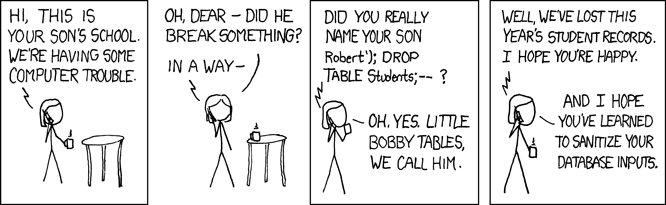
  • Bad people can do bad stuff

    Picture from xkcd.

  • Stuff simply didn't solve whatever stuff was suppose to solve
    The new wizard (not the cool magical kind, the nasty GUI kind) was suppose to simplify the creation of new documents but now the user is presented with so many options they could earlier ignore it's just insanely complex! What a heck is document structure template, I just want a new document, damn it!
Dora looks for all this to help Bob and Cody (and Angie) look good so that users (and managers) won't come with pitchforks trying to end their lives. She also helps stakeholders like Angie and others make better decisions by providing them as much valuable information as possible about the application's shape. To make sure good decisions about the application can be made it's important Dora, just like Angie, is a great communicator.

Some people think Dora's job is about making sure 2+2 is 4. They are the same people who wouldn't care if the meat they buy is rotten as long as it's packaged according to spec. Others think Dora is a sadistic mistress, which she might be, but not during working hours. If she was she would just stay quiet about problems found and see the programmers run in panic as users storm the building with their pitchforks.

- You just want to see stuff break, Dora!
- No, but I rather see it break here than in the face of thousands of users

I'm Dora! Or well, I'm not, but this is what I do, I'm a tester!